Calligraphy and the brush
Chinese calligraphy is both writing and visual art. A work is read through the structure of its characters, but also through pressure, speed, spacing, ink tone and the movement of the brush. Script styles developed for different contexts, from formal inscriptions to rapidly written cursive forms.
Calligraphy became closely connected to education and cultivated identity. It could appear on paper, silk, stone rubbings, architecture and objects. The Metropolitan Museum of Art’s introduction emphasizes the inner life of brushwork and provides a useful route into named works and historical styles.
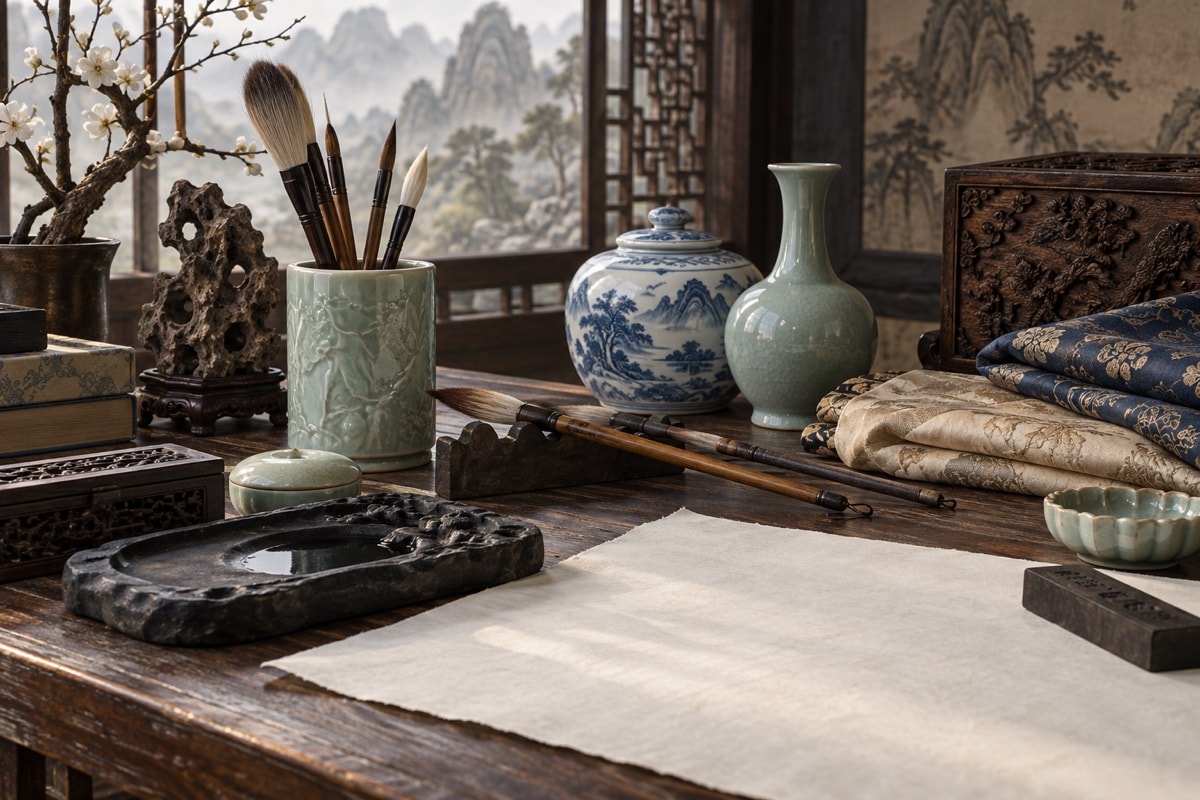
Brush, ink, paper and inkstone are conventionally called the “four treasures of the study.” The brush holds liquid ink in flexible hairs; an inkstick is ground with water on an inkstone. Paper differs in absorbency, so the same stroke can spread or remain sharply edged on different sheets.
Painting, poetry and place
Chinese painting includes court art, religious images, portraits, narrative scenes, bird-and-flower subjects and expansive traditions of landscape. Ink painting is not simply colorless representation. Variations in moisture, density, line and empty space create atmosphere, texture and rhythm.
Scholar-artists often brought painting, calligraphy and poetry together in one work. A landscape could be a record of travel, a social gift, an imagined retreat or a meditation on earlier masters. Looking closely at format matters: a handscroll unfolds through time, while a hanging scroll creates a field encountered more nearly at once.
Ceramics and material knowledge
Ceramics reveal long experiments with clay bodies, glazes, kiln temperatures, forms and painted decoration. Vessels moved through households, courts, temples, tombs and international trade. Porcelain became especially influential abroad, but earthenware and stoneware are equally important to the history of technique and use.
Objects should be read in context. A bowl, jar or figurine can tell a story about production centers, dining, burial, collecting or exchange. Museum catalogues are valuable because they connect visual qualities to material evidence and careful dating rather than treating every object as a timeless symbol.
Music, opera and performance
Chinese musical history includes court ensembles, literati instruments, regional theatre, narrative song and many local traditions. The qin acquired strong associations with scholarly self-cultivation, while other instruments served ritual, popular entertainment and opera. Tuning systems, notation and performance settings changed across time.
Chinese opera is a broad family rather than one form. Beijing opera is internationally familiar, but regional genres differ in vocal style, instrumentation, movement, costume and repertoire. Performance joins music, speech, gesture and visual convention, making it as much a theatrical language as a collection of stories.
Chinese opera also uses recognizable role categories. Sheng broadly denotes male roles, dan female roles, jing painted-face roles and chou comic roles. Subtypes differ in voice, movement and costume, while regional genres organize these conventions differently. These categories give a viewer a way to follow stage roles without treating them as complete descriptions of a character’s personality.
The classic novels
Four works are commonly grouped as the great classical novels: Romance of the Three Kingdoms, Water Margin, Journey to the West and Dream of the Red Chamber. Each has a long textual and performance history. Editions differ, and stories circulated through theatre, storytelling and illustration as well as print.
Together the novels range across war and statecraft, outlaw brotherhood, pilgrimage and the intimate world of an elite household. They should not crowd out other literature, but they provide useful gateways into narrative traditions. The earlier Index China page also named Story of the Western Wing, a celebrated drama, showing how lists of “classics” can vary by genre and purpose.
How to look and listen
Art-historical description begins with the object before moving to symbolism. Note scale, format, material, line, surface and signs of use. A handscroll asks the viewer to move through an image, while a ceramic vessel joins profile, volume, weight and touch. These physical conditions shape meaning.
Performance requires the same patience. Operatic gesture, instrumental timbre and vocal style have conventions learned by performers and audiences. Short summaries can identify a form, but recordings, translations and documented collections are needed to encounter its regional and historical specificity.
Sources & further reading
- museum introduction to Chinese calligraphy — Calligraphy
- museum essay on Chinese painting — Painting