Agriculture and the reform era
Agriculture was among the first sectors transformed in the reform period that began in the late 1970s. The household responsibility system shifted day-to-day production decisions toward rural households while land remained collectively owned. Procurement and market arrangements also changed over time.
The effects extended beyond fields. Higher productivity and changing incentives released labor for township enterprises and later urban employment, while rural incomes and consumption changed unevenly. Agriculture was therefore both a sector and a starting point for wider economic transformation.
Land, water and regional difference
China’s farming regions differ sharply. Northern systems depend heavily on wheat, maize and managed water, while rice is prominent across many southern and central areas. Uplands, grasslands, river deltas and dry interior zones create different combinations of crops, livestock and risk.
Water availability, soil condition and extreme weather remain fundamental constraints. Irrigation and flood control have long histories, but infrastructure alone cannot resolve every conflict among agriculture, cities, industry and ecosystems. A regional view prevents one successful technique from being treated as a national template.
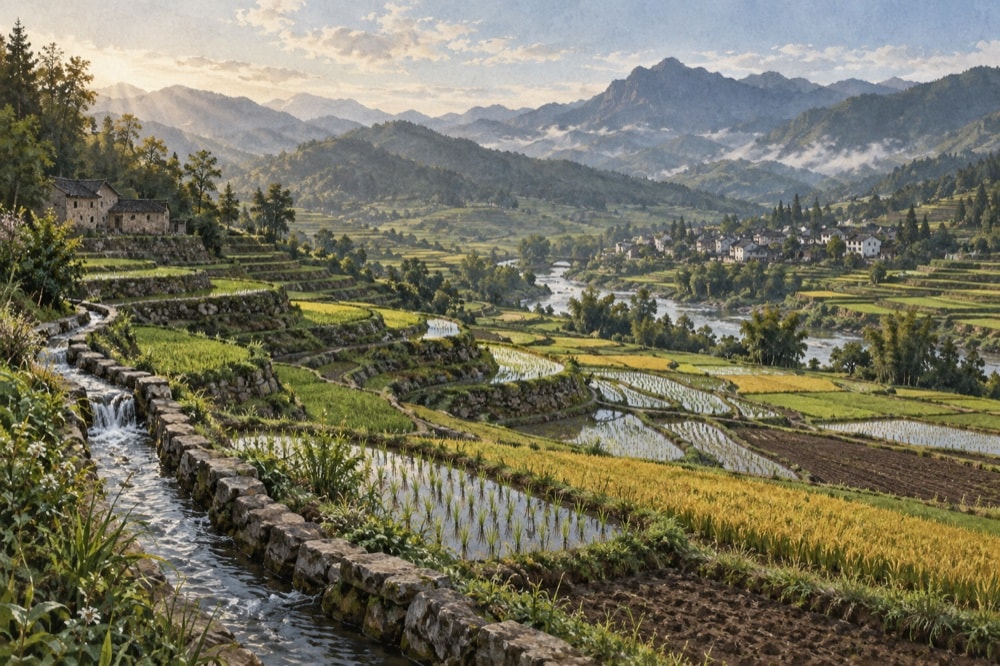
Terraces divide a hillside into stepped fields. Bunds—the raised edges around fields—can retain water in rice-growing landscapes, while channels connect fields to water sources. Not every terrace carries rice: the crop depends on local moisture, temperature and farming practice. A photograph’s stepped pattern alone cannot establish what is grown.
Technology and knowledge
Plant breeding, mechanization, fertilizer, pest management, remote sensing, cold chains and logistics have all changed agricultural production. Their value depends on scale, crop, labor, finance and environmental conditions. Smallholders and larger operations may use the same technology differently.
Knowledge moves through public research institutes, universities, extension networks, cooperatives, enterprises and farmers’ own experimentation. The most useful innovations fit local systems and can be maintained, rather than merely appearing advanced. Historical study also shows that technology is inseparable from institutions and incentives.
Rural change and food systems
Urbanization and migration altered village demographics and the organization of work. Some households combine farming with off-farm income; others lease land or specialize. Better transport and digital marketplaces can widen access to buyers, while volatile prices and uneven bargaining power remain challenges.
Food systems connect farms to storage, processing, retail and household diets. Environmental quality, food safety, waste and resilient supply chains now sit beside output as major questions. FAO’s China materials provide institutional context and statistical resources, but figures should always be read with their date, definition and geographic scope.
How to read period statistics
Agricultural writing from the 1980s and 1990s often assembled striking figures. This page does not repeat numbers whose source and denominator cannot be verified. Period claims can change depending on whether they describe mainland China, a calendar year, a crop year, rural residents or the whole population.
A sound comparison starts with the metadata: source agency, reference date, unit, coverage and later revisions. That approach keeps attention on reform, challenge and technology without turning historical figures into current agricultural advice.
A farming calendar distinguishes sowing, growth and harvest, and may follow more than one crop on the same land. Winter wheat spans the cold season before a later harvest. A crop year therefore need not match a calendar year. Comparing accounts of village labor requires noting both the crop and the stage of cultivation.
Environmental questions
Agricultural history is also environmental history. Cultivation changes soil, waterways and habitats, while farming communities respond to drought, flood, erosion and changing seasons. Policies that raise output can create different pressures depending on crop and region.
Sustainability is therefore not one technique. It involves water allocation, soil health, nutrient use, biodiversity, energy, waste and the livelihoods of people maintaining the land. Long-term study has to examine trade-offs as well as aggregate production.
Climate adds uncertainty to planning and historical comparison. Changes in temperature, precipitation and extreme events interact with irrigation, planting choices and market conditions. A reference page can identify those connections without turning them into a forecast for a particular farm or season.
Sources & further reading
- Food and Agriculture Organization’s China portal — Institutional and statistical context