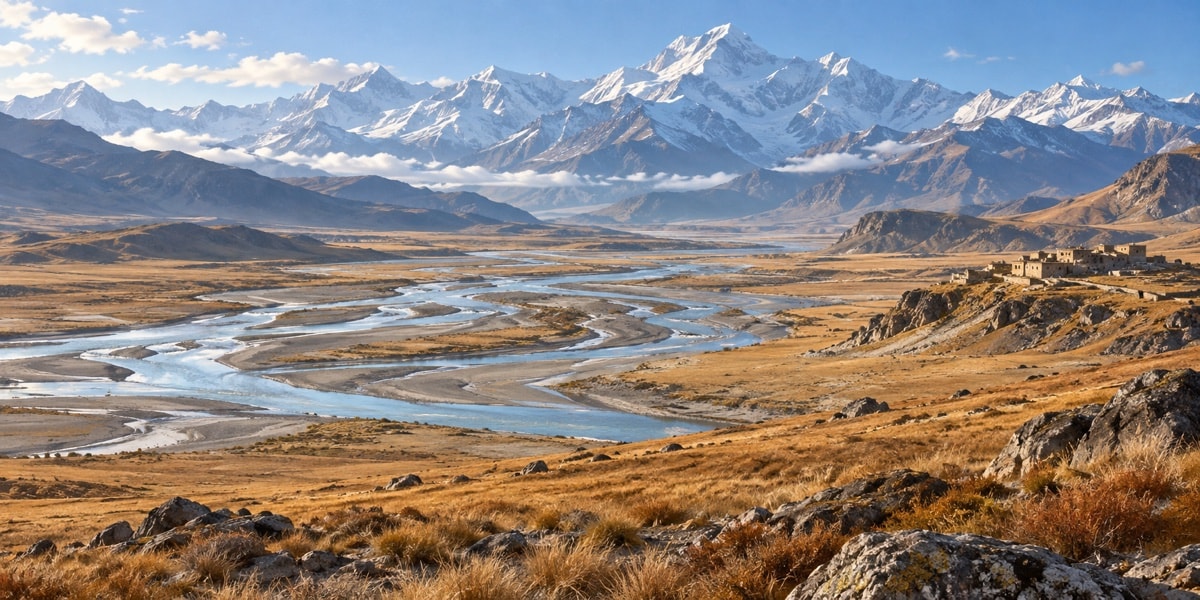
Plateau geography
Tibet occupies a vast high-altitude region north of the Himalayas. Much of the landscape lies on the Tibetan Plateau, where mountain ranges, broad valleys, grasslands, lakes and the headwaters of major Asian rivers shape settlement and travel. Lhasa sits in a river valley in the plateau’s south-central area and has long been an important religious, administrative and cultural center.
Altitude, dry air and strong seasonal contrasts affect agriculture and pastoral life. Barley cultivation, yak and sheep herding, trade routes and monastic centers developed in relation to this environment. The plateau is not culturally uniform: local histories, speech varieties, livelihoods and connections across neighboring regions differ considerably.
Tibetan people, language and Buddhism
The Tibetan language belongs to the Tibetic branch of the Sino-Tibetan language family and is written in a script developed in the early imperial period. Regional speech varieties can differ substantially. Tibetan literature includes religious works, historical chronicles, biographies, poetry, medicine and oral traditions, so language is both an everyday medium and a major carrier of cultural memory.
Tibetan Buddhism developed through sustained exchange with Indian Buddhist traditions and through institutions formed on the plateau. Different schools created distinctive bodies of teaching, monastic organization, art and scholarship. The Potala Palace, Jokhang Temple Monastery and Norbulingka form a major ensemble in Lhasa; the UNESCO description emphasizes their architectural, religious and administrative significance.
Tang and Tubo
The Tibetan Empire, often called Tubo in Chinese historical writing, was a major power during the Tang dynasty. Relations between the two courts included warfare, diplomacy, marriage alliances and exchanges of envoys. Princess Wen Cheng’s marriage to Songtsen Gampo in the seventh century became a durable subject in later historical memory, but it should not be treated as a simple explanation for every later political relationship.
A treaty concluded in the early ninth century was recorded on an inscribed pillar traditionally dated to 823 near the Jokhang in Lhasa. Its language presents the Tang and Tibetan rulers as parties to an agreement. The monument is valuable precisely because it is a contemporary record of diplomacy between powerful neighbors, not a shortcut to modern claims.
Yuan, Ming and Qing frameworks
Under the Yuan dynasty, the imperial court created institutions that joined Buddhist affairs with administration of Tibetan regions and maintained relations with Tibetan religious leaders. Scholars differ over how Yuan rule should be mapped onto later ideas of sovereignty. A neutral account can describe the institutions and the reach of Mongol imperial power without pretending the later debate is settled by one label.
Ming courts granted titles, received tribute and maintained varied relationships with Tibetan leaders, while the actual intensity of administration differed across periods and places. Qing rule introduced new military and administrative arrangements and formal relations with senior Tibetan Buddhist hierarchs. Each dynasty used the political vocabulary and institutions of its own time; applying modern categories backward requires care.
The twentieth century and the present region
The end of the Qing dynasty, the Republican period, British involvement in the Himalayan region, the establishment of the People’s Republic of China and events in the 1950s are interpreted differently by governments, Tibetan exile institutions and historians. This page does not instruct readers which political conclusion to adopt. It separates agreed chronology from disputed claims and directs attention to named sources when a position needs attribution.
The Tibet Autonomous Region is an administrative region of the People’s Republic of China, with Lhasa as its capital. Tibetan cultural life also extends beyond its boundaries into neighboring provinces and communities abroad. Contemporary study spans language preservation, religious institutions, heritage conservation, urban development, pastoral livelihoods and environmental change. Those subjects are best examined through evidence and through multiple clearly identified perspectives.
Sources & further reading
- UNESCO’s account of the historic ensemble in Lhasa — Heritage description